Quick Answer: What Makes a Good Switchgear Manufacturer?
A reliable medium voltage switchgear manufacturer should meet all eight of these criteria: internationally recognized certifications (IEC/ISO/CE), sufficient production capacity for your project timeline, proven technical capability with in-house R&D, a broad product line covering your voltage and application requirements, willingness and ability to customize, competitive lead times (4-8 weeks for standard products), responsive after-sales service with spare parts availability, and transparent pricing with no hidden costs. Below we break down each criterion with specific benchmarks and red flags to watch for.
Why Your Choice of Switchgear Manufacturer Matters
Medium voltage switchgear protects people and equipment in power distribution networks operating at 1 kV to 40.5 kV. A failure in switchgear can cause arc flash incidents (with temperatures exceeding 20,000°C), prolonged power outages, and equipment damage costing hundreds of thousands of dollars. The manufacturer you choose directly determines the safety, reliability, and total cost of ownership of your electrical infrastructure over its 25-30 year service life.
Unlike commodity products, switchgear is a complex engineered system where design quality, manufacturing precision, and testing rigor all matter. Two panels that look identical on a datasheet can have vastly different real-world performance depending on the manufacturer's material sourcing, welding quality, busbar design, and type-test validation. This guide gives you a systematic framework for evaluating switchgear manufacturers so you can make an informed selection.
Criterion 1: Certifications and Type-Test Reports
Certifications are the single most important qualification criterion. They provide independent, third-party verification that the manufacturer's products meet international performance standards.
Must-have certifications:
- IEC 62271 type-test reports — Specific to each product family (62271-100 for circuit breakers, 62271-200 for switchgear, 62271-203 for GIS). These reports confirm that the equipment has passed short-circuit withstand, temperature rise, dielectric, and internal arc tests.
- ISO 9001:2015 — Quality management system certification, ensuring consistent manufacturing processes.
- ISO 14001:2015 — Environmental management system, increasingly required by utilities and EPC contractors.
- CE marking — Required for switchgear exported to the European Union and widely recognized globally.
Bonus certifications that signal higher quality:
- KEMA (Netherlands) or CESI (Italy) type-test certificates — These are the most respected independent test labs for medium voltage equipment.
- CCC (China Compulsory Certification) — Required for domestic Chinese market, confirms basic safety compliance.
- ASTA (UK) or UL (USA) — Regional certifications for specific export markets.
Red flag: A manufacturer that cannot provide original type-test reports (not just certificates of conformity) for the specific products you are purchasing. Ask to see the actual test reports with oscillograms and measurement data.
NAIJI Electric holds IEC type-test reports for its full product range, including the ASN series air-insulated switchgear, GSN series gas-insulated switchgear, and VN/CE series vacuum circuit breakers. All reports are available for customer review upon request.
Criterion 2: Production Capacity
Evaluate whether the manufacturer's factory can handle your project volume and timeline. Key metrics to assess:
- Annual output: A mid-size manufacturer typically produces 3,000-8,000 switchgear panels per year. A large manufacturer exceeds 10,000 panels/year.
- Factory floor area: A well-equipped medium voltage switchgear factory needs at least 10,000 m² for production, testing, and warehousing.
- Testing lab: An in-house routine test lab is essential. Routine tests (power frequency withstand, partial discharge, mechanical operation) should be performed on every panel before shipment.
- Workforce: Skilled technicians for assembly, wiring, and testing are the bottleneck — not floor space. Ask about the number of trained electricians and their average experience.
Visit the NAIJI Electric factory page to see our 20,000+ m² production facility, automated welding lines, and fully equipped testing laboratory.
Criterion 3: Technical Capability and R&D
A manufacturer with genuine R&D capability can solve problems, optimize designs, and support you technically throughout the product lifecycle. Look for:
- In-house design team: Engineers who can modify standard designs to meet your specific requirements (non-standard dimensions, special bus ratings, integrated protection relays).
- 3D modeling and simulation: Modern manufacturers use CAD/CAE tools for thermal analysis, dielectric simulation, and arc-fault containment design.
- Patent portfolio: Patents indicate genuine innovation, not just copying existing designs.
- New product development: Ask what products they have launched in the last 3 years. Active R&D means the manufacturer is investing in the future.
Learn more about NAIJI Electric's engineering capabilities on our About page.
Criterion 4: Product Line Breadth
A broad product line means you can source more of your project's switchgear from a single manufacturer, simplifying procurement, reducing shipping costs, and ensuring compatibility across equipment.
| Product Category | Why It Matters | NAIJI Coverage |
|---|---|---|
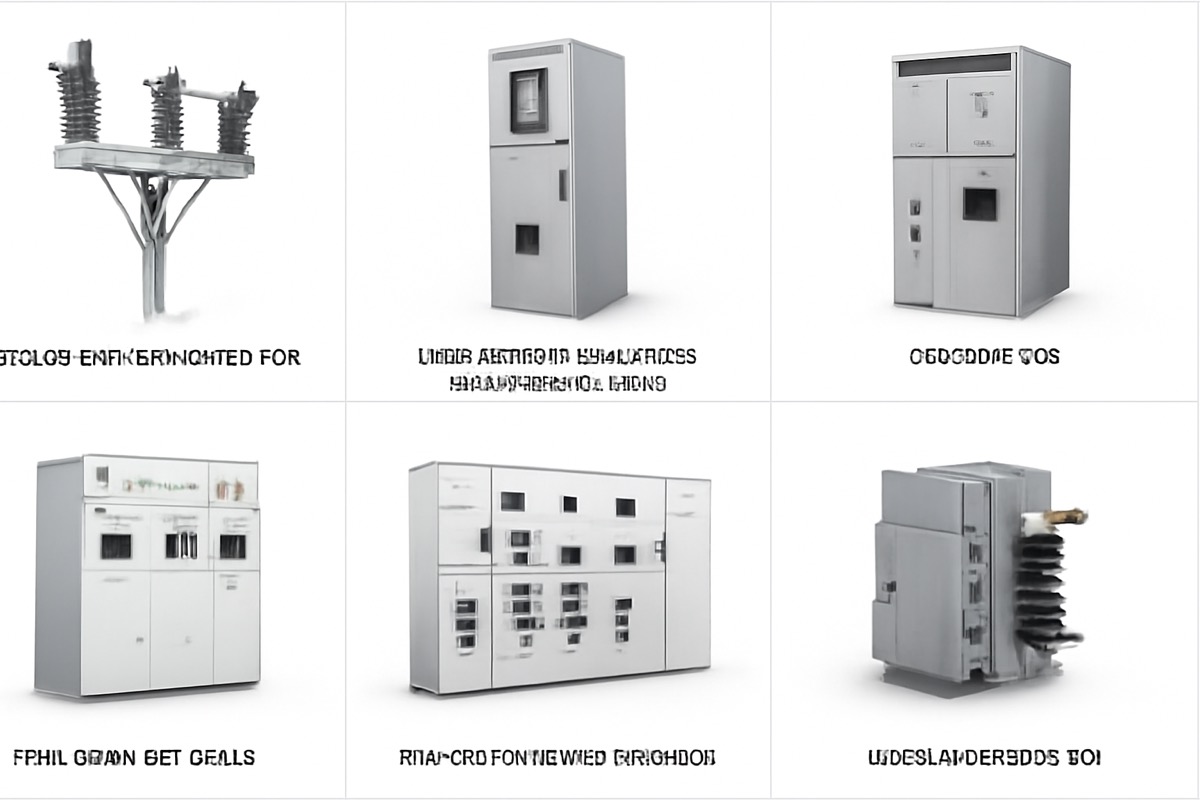
| Air-insulated switchgear (AIS) | Most common MV switchgear type, used in substations and industrial plants | ASN series — 12 kV to 40.5 kV |
| Gas-insulated switchgear (GIS) | Compact solution for space-constrained installations | GSN series — 12 kV to 40.5 kV |
| Vacuum circuit breakers | Core protection device in all MV switchgear | VN/CE series — 12 kV to 40.5 kV, up to 4000 A |
| Ring main units (RMU) | Compact switching for urban distribution networks | XGN15 series |
| Vacuum contactors | Frequent-switching applications (motors, capacitor banks) | CEC series |
| Low voltage switchgear | Complete substation solution from MV to LV | GCS/GGD series |
Criterion 5: Customization Capability
Every project is different. Your switchgear manufacturer should be able to accommodate:
- Non-standard dimensions: Modified panel width, height, or depth to fit existing switchgear rooms.
- Special bus ratings: Non-standard current ratings (e.g., 2500 A or 3600 A) or bus configurations.
- Integrated protection: Pre-wired protection relays, metering CTs/VTs, and communication modules.
- Custom paint and labeling: RAL colors, customer logos, and bilingual nameplates.
- Seismic qualification: Modified structures for earthquake-prone regions (IEC 62271-300).
Ask for examples of past customization projects. A manufacturer that has only ever produced standard catalog products may struggle with custom requirements.
Criterion 6: Lead Time and Logistics
Lead time benchmarks for medium voltage switchgear:
| Product Type | Standard Lead Time | Custom Lead Time |
|---|---|---|
| Air-insulated switchgear (AIS) | 4-6 weeks | 6-10 weeks |
| Gas-insulated switchgear (GIS) | 6-8 weeks | 8-12 weeks |
| Vacuum circuit breaker (standalone) | 2-4 weeks | 4-6 weeks |
| Ring main unit (RMU) | 4-6 weeks | 6-8 weeks |
| Complete substation package | 8-12 weeks | 12-16 weeks |
Also evaluate the manufacturer's logistics capability: Do they have experience with export packing (seaworthy wooden crates)? Can they arrange FOB, CIF, or DDP shipping? Do they handle export documentation (commercial invoice, packing list, certificate of origin, fumigation certificate)?
Criterion 7: After-Sales Service
Switchgear has a 25-30 year service life. Your relationship with the manufacturer extends far beyond the initial purchase. Evaluate:
- Spare parts availability: Can they guarantee spare parts supply for at least 15 years? Do they stock common spares (vacuum interrupters, operating mechanisms, auxiliary contacts)?
- Technical support response time: What is their typical response time for technical queries? Is support available in your language and time zone?
- On-site commissioning: Do they offer commissioning engineers to supervise installation and testing? What are the costs?
- Warranty terms: Standard industry warranty is 18 months from shipment or 12 months from commissioning, whichever comes first. Anything shorter is a red flag.
- Training: Do they provide operation and maintenance training for your personnel?
Criterion 8: Pricing and Total Cost of Ownership
The lowest unit price is rarely the best value. Evaluate total cost of ownership (TCO) over the switchgear's service life:
- Initial purchase price: The quoted price should include routine testing, standard packing, and documentation.
- Shipping and import duties: FOB price comparisons are more meaningful than CIF because they separate the manufacturer's price from logistics costs you can optimize independently.
- Installation cost: Well-designed switchgear with clear wiring diagrams and pre-terminated cables reduces installation time and cost.
- Maintenance cost: Vacuum-based switchgear has significantly lower maintenance costs than SF6-based equipment over a 25-year lifecycle.
- Energy losses: Bus resistance and contact resistance cause continuous energy losses — higher-quality copper busbars and silver-plated contacts reduce these losses.
- Spare parts cost: Check the price of key replacement parts (vacuum interrupters, closing springs, auxiliary contacts) before committing to a manufacturer.
Manufacturer Evaluation Scoring Checklist
Use this checklist to score potential switchgear manufacturers on a 1-5 scale for each criterion. A total score of 32 or above (out of 40) indicates a strong supplier.
| Criterion | Weight | Score (1-5) | What to Verify |
|---|---|---|---|
| 1. Certifications | High | ___ | IEC type-test reports, ISO 9001/14001, CE |
| 2. Production capacity | High | ___ | Factory tour, annual output, test lab |
| 3. Technical capability | High | ___ | R&D team, patents, recent new products |
| 4. Product line breadth | Medium | ___ | Catalog coverage, voltage range |
| 5. Customization | Medium | ___ | Past custom project examples |
| 6. Lead time | Medium | ___ | Confirmed delivery schedule, penalties |
| 7. After-sales service | High | ___ | Warranty, spare parts, support response |
| 8. Pricing / TCO | Medium | ___ | FOB quote, spare parts prices, payment terms |
Why Engineers Choose NAIJI Electric
Established in 2001 as a Sino-Korean joint venture, NAIJI Electric has been manufacturing medium voltage switchgear for over 25 years, supplying equipment to power utilities, industrial plants, renewable energy projects, and infrastructure developments in 20+ countries. Here is how we measure up against the 8 criteria:
- Certifications: Full IEC 62271 type-test reports (KEMA-tested), ISO 9001, ISO 14001, CE marking
- Production capacity: 20,000+ m² factory, 5,000+ panels/year capacity
- Technical capability: 30+ R&D engineers, 50+ patents, new product launches every year
- Product range: AIS, GIS, VCB, RMU, contactors, LV switchgear — complete substation solutions
- Customization: 40%+ of orders are custom configurations
- Lead time: 4-6 weeks standard, expedited options available
- After-sales: 24-month warranty, 15-year spare parts guarantee, multilingual technical support
- Pricing: Factory-direct pricing with transparent FOB quotations
Ready to discuss your switchgear project? Contact NAIJI Electric for a technical consultation and quotation.