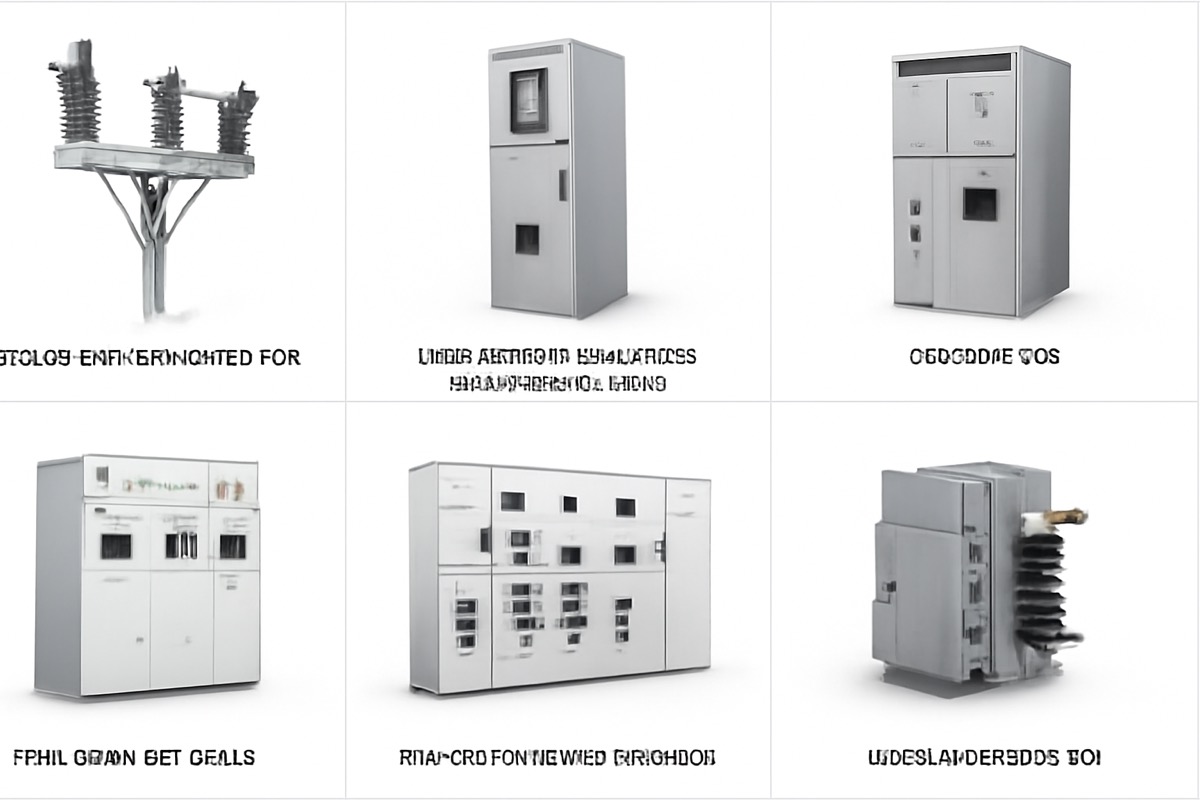
Overview: How Switchgear Is Classified
Switchgear is not a single product — it is a broad family of equipment used to control, protect, and isolate electrical circuits. Engineers classify switchgear along five dimensions, and understanding these classifications is essential for specifying the right equipment.
| Classification Dimension | Categories |
|---|---|
| 1. Voltage Level | Low voltage (LV), Medium voltage (MV), High voltage (HV) |
| 2. Insulation Medium | Air (AIS), Gas (GIS), Oil, Vacuum, Solid |
| 3. Construction Type | Metal-clad, Metal-enclosed, Open-type |
| 4. Installation | Indoor, Outdoor, Pole-mounted, Underground |
| 5. Function | Circuit breaker panel, Load break switch, RMU, MCC, Metering |
1. Types by Voltage Level
Low Voltage Switchgear (below 1 kV)
LV switchgear operates at 230-690 V and distributes power within buildings and facilities. It uses air circuit breakers (ACB), molded case circuit breakers (MCCB), and miniature circuit breakers (MCB) as protective devices.
Common types include draw-out switchgear panels (like the GCS series, up to 4000 A), fixed-type panels (like the GGD series), and motor control centers (MCCs). The EZMX1 air circuit breaker (up to 6300 A / 135 kA) is one of the world's most compact ACBs used in LV main incoming panels.
Medium Voltage Switchgear (1 kV - 52 kV)
MV switchgear is the largest and most diverse category. It uses vacuum or SF6 circuit breakers and serves as the backbone of power distribution networks. The most common ratings are 12 kV, 24 kV, and 40.5 kV. For a deep dive into voltage classes and selection criteria, see our medium voltage switchgear guide.
NAIJI Electric's MV lineup spans the full range: metal-enclosed switchgear panels (ASN series), gas-insulated switchgear (GSN series), outdoor vacuum circuit breakers (ZW32), and indoor vacuum circuit breakers (VN/CE/CVG series).
High Voltage Switchgear (above 52 kV)
HV switchgear operates at transmission voltages (66 kV to 800 kV) and is typically installed in large outdoor substations or as GIS in compact indoor substations. It uses SF6 as the primary interrupting and insulating medium at these voltage levels.
2. Types by Insulation Medium
Air-Insulated Switchgear (AIS)
AIS uses atmospheric air for insulation between live parts. It is the simplest, most economical, and most widely used type at both LV and MV levels. Air provides adequate insulation at moderate voltages but requires larger clearance distances than gas insulation.
- Advantages: Low cost, simple construction, easy to inspect and extend, no gas handling
- Disadvantages: Large footprint, sensitive to dust/humidity/pollution, requires regular cleaning
- Example: ASN3-12 — 12 kV AIS with vacuum circuit breakers, up to 5000 A / 50 kA
Gas-Insulated Switchgear (GIS)
GIS encloses all live components in sealed metal housings filled with an insulating gas, typically SF6 or nitrogen. The superior dielectric strength of the gas allows 50-80% size reduction compared to AIS.
- Advantages: Extremely compact, immune to environment, maintenance-free gas compartment, excellent reliability
- Disadvantages: Higher cost, requires gas handling for maintenance, SF6 is a potent greenhouse gas
- Example: GSN3-12 — 12 kV C-GIS with eco-friendly nitrogen insulation, 3150 A / 40 kA
For a detailed comparison, see our guide: What Is Gas-Insulated Switchgear (GIS)?
Vacuum-Insulated Switchgear
While vacuum is primarily used as an arc-extinguishing medium inside interrupters, some modern designs use vacuum for both switching and insulation, eliminating the need for any gas. This emerging technology is still maturing but represents the future of truly SF6-free switchgear.
Oil-Insulated Switchgear
Oil circuit breakers use mineral oil for both insulation and arc extinguishing. Once dominant at MV and HV, they have been largely replaced by vacuum and SF6 technology due to fire risk, maintenance burden, and environmental concerns. Oil breakers are still found in older installations worldwide.
3. Types by Construction
Metal-Clad Switchgear
The highest level of construction: grounded metal barriers separate every functional compartment (bus, breaker, cable, control). The circuit breaker must be draw-out (withdrawable). Automatic shutters seal openings when the breaker is removed. Provides the best arc containment and maintenance safety.
Metal-Enclosed Switchgear
A grounded metal enclosure surrounds the assembly, but internal barriers between compartments are not mandatory. Can use either draw-out or fixed-mount breakers. More compact and cost-effective than metal-clad.
For a detailed comparison: Metal Clad vs Metal Enclosed Switchgear
Open-Type Switchgear
Components mounted on open frames without full enclosure. Used mainly at high voltage in outdoor substations where equipment is spaced far apart. Rarely used at medium voltage in modern installations.
4. Types by Installation
Indoor Switchgear
Designed for installation in electrical rooms, substations, or buildings. Protected from weather but requires adequate ventilation and clearance space. Most MV switchgear in commercial and industrial settings is indoor type.
- Examples: ASN3-12, ASN2-24, ASN1-40.5 panels; VN3-12E, CE-12 circuit breakers
Outdoor Switchgear
Designed to withstand rain, sun, wind, ice, and temperature extremes. Uses weatherproof enclosures (IP ratings) or inherently weather-resistant construction. Common for distribution networks and rural substations.
Pole-Mounted Switchgear
A subset of outdoor switchgear mounted directly on overhead line poles. Used extensively in rural and semi-urban distribution networks. Includes pole-mounted circuit breakers, load break switches, and reclosers.
Underground / Pad-Mounted
Installed at ground level or below ground in urban areas where overhead lines are not permitted. Ring main units (XGN15-12) are the primary switchgear type for underground cable networks.
5. Types by Function
Circuit Breaker Panels
The core function: contain a circuit breaker for protecting and switching feeders, transformers, generators, or motors. Available with vacuum breakers (VCB) or SF6 breakers.
Ring Main Units (RMU)
Compact switchgear for cable distribution networks, combining load break switches and fuse switches in modular configurations. Used at every distribution point in urban underground networks. XGN15-12 offers multiple module combinations (2L+1F, 2V+1F, etc.).
Load Break Switch Panels
Contain load break switches (LBS) for sectionalizing feeders. Can interrupt load current but not fault current. Often used at distribution branch points and customer boundaries.
Contactor Panels
Contain vacuum contactors for frequent switching of motors and capacitor banks. Designed for high duty cycles (hundreds of thousands of operations) that would wear out a circuit breaker.
Motor Control Centers (MCC)
Specialized LV or MV switchgear assemblies containing multiple motor starter units. Each unit includes a contactor or circuit breaker, overload relay, and control circuitry for one motor. GCS draw-out switchgear is commonly used as the platform for LV MCCs.
Metering Panels
Contain voltage and current transformers for revenue metering and system monitoring. Often combined with a disconnect switch or circuit breaker in the same switchgear lineup.
Key Standards for Each Switchgear Type
Every switchgear type must comply with specific international standards that define design requirements, testing procedures, and safety classifications. Specifying the correct standard in your procurement documents ensures you receive equipment that has been independently verified for your application. For a detailed guide to the most important medium voltage standard series, read our IEC 62271 switchgear standard guide.
| Switchgear Type | Primary Standard | Key Test Requirements |
|---|---|---|
| MV Circuit Breakers (VCB/SF6) | IEC 62271-100 | Short-circuit breaking, mechanical endurance (M1/M2), dielectric withstand |
| Metal-Enclosed Switchgear Panels | IEC 62271-200 / IEEE C37.20.3 | IAC internal arc, temperature rise, partition class (PM/PI), LSC category |
| Metal-Clad Switchgear | IEEE C37.20.2 | All IEC 62271-200 tests + draw-out mechanism, automatic shutters |
| Gas-Insulated Switchgear (GIS) | IEC 62271-203 | Gas tightness, partial discharge, gas monitoring, all 62271-200 tests |
| Ring Main Units (RMU) | IEC 62271-200 + 62271-105 | Switch-fuse combination, cable-charging, loop-switching duties |
| Load Break Switches | IEC 62271-103 | Load switching duties, earth fault making, cable-charging current |
| Vacuum Contactors | IEC 62271-106 | High-duty-cycle endurance (100,000+ operations), motor starting |
| LV Switchgear Assemblies | IEC 61439-1/2 | Temperature rise, short-circuit withstand, IP rating |
When evaluating manufacturers, the most important document to request is the type-test report from an accredited independent laboratory. Learn what to look for in test reports in our switchgear testing standards and procedures guide.
Emerging Switchgear Technology Trends (2026)
The switchgear industry is undergoing significant transformation driven by environmental regulation, digitalization, and grid modernization:
- SF6-free transition: The EU F-Gas Regulation is accelerating the shift to SF6-free switchgear at medium voltage. Nitrogen, dry air, and vacuum-solid insulation are replacing SF6 in new installations. See our detailed regulatory compliance guide for timeline
- Digital switchgear: IEC 61850 communication, embedded IoT sensors for condition monitoring, and AI-powered predictive maintenance are transforming switchgear from passive equipment into intelligent grid assets. NAIJI Electric's ASN3i-12 represents this trend
- Compact design evolution: Urban space constraints drive demand for ultra-compact designs like the ASN550 (550 mm depth) and integrated compact substations that combine RMU, transformer, and LV panel in a single enclosure
- Renewable integration: Solar and wind generation growth is creating demand for specialized switchgear configurations at collector substations, with particular requirements for bidirectional power flow and fast-acting protection. See our industrial applications guide for details
- Extended mechanical life: Next-generation vacuum interrupters with advanced CuCr contact materials are achieving 30,000-50,000 operations — 3-5x the life of previous designs
Switchgear Protection and Coordination
No switchgear classification discussion is complete without addressing protection coordination — the systematic coordination of protective devices to ensure that only the device nearest to a fault operates, minimizing the impact on the rest of the network.
Key protection elements integrated into or coordinated with switchgear include:
- Overcurrent relays (50/51): The most common protection — detect fault currents and trip the associated circuit breaker. Inverse-time and definite-time settings must be coordinated between upstream and downstream devices
- Earth fault relays (50N/51N): Detect ground faults, which are the most common fault type (70-80% of all faults in MV networks). Proper earthing system design is essential for earth fault protection to work correctly
- Differential relays (87): High-speed protection for transformers and bus sections — trips in less than 30ms for internal faults
- Arc flash relays: Optical sensors detect the light from an arc flash and trip the upstream breaker in less than 50ms, dramatically reducing incident energy
For a complete guide to selecting and coordinating protection relays with medium voltage switchgear, see our protection relay types and selection guide. For short-circuit rating calculations needed for relay setting studies, see our kA rating guide.
How to Select the Right Type
| Decision Factor | Recommended Type |
|---|---|
| Standard 12 kV industrial substation | Metal-enclosed AIS with vacuum breakers (ASN3-12) |
| Space-constrained urban substation | Gas-insulated C-GIS (GSN3-12) |
| Underground cable network | Ring main unit (XGN15-12) |
| Rural overhead distribution | Pole-mounted VCB (ZW32-12) |
| Commercial building (office/bank/data center) | Compact switchgear (ASN550, 550 mm depth) |
| Smart grid with remote monitoring | Intelligent switchgear (ASN3i-12 with IEC 61850) |
| Frequent motor switching | Vacuum contactor panel (CEC) |
| 40.5 kV high-voltage class | 40.5 kV switchgear (ASN1-40.5) or GIS (GSN1-40.5L) |
| SF6-free / eco-friendly requirement | Nitrogen-insulated GIS (GSN3-12) |
For a more focused comparison of medium voltage switchgear types specifically, see our MV switchgear classification guide and MV switchgear selection guide. For project-specific switchgear selection guidance, contact the NAIJI Electric engineering team.