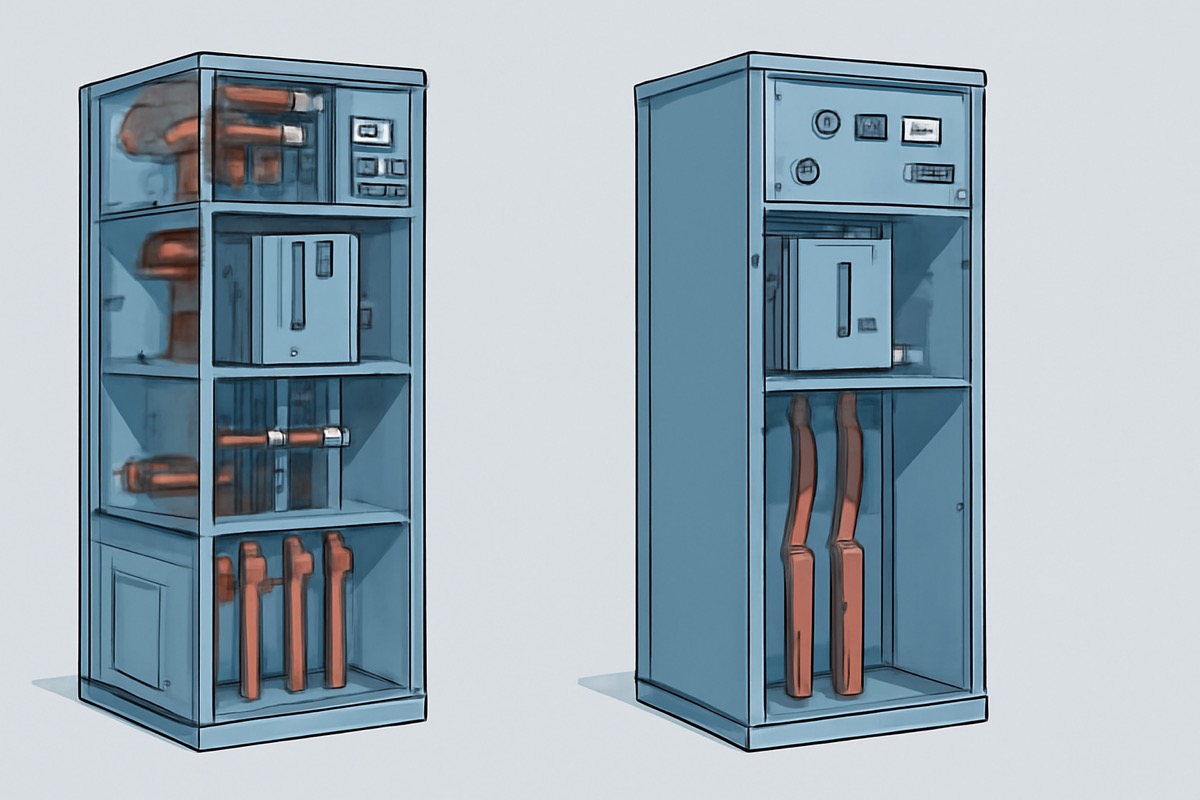
Quick Answer: Metal-Clad or Metal-Enclosed?
Choose metal-clad switchgear when safety during maintenance is paramount: critical substations, utility-owned equipment, and any installation where operators routinely access individual compartments while adjacent sections remain energized. Choose metal-enclosed switchgear when space and budget are constrained: commercial buildings, data centers, and installations where the equipment is accessed infrequently. Below we compare both types across construction, safety, cost, and real-world application.
Definitions: What the Standards Actually Say
The terms "metal-clad" and "metal-enclosed" have precise definitions in international standards. Understanding these definitions is critical because using the wrong type for a given application can result in code violations, safety hazards, and costly rework. Both fall under the broader category of medium voltage switchgear.
Metal-Enclosed Switchgear (IEC 62271-200 / GB 3906): Any switchgear assembly enclosed by a grounded metal housing. This is the broad, umbrella category. The enclosure provides basic protection against accidental contact with live parts and external environmental factors. However, the standard does not mandate internal barriers between every functional section.
Metal-Clad Switchgear (IEEE C37.20.2): A specific subset of metal-enclosed switchgear that requires grounded metal barriers between every major compartment — the main bus compartment, the circuit breaker compartment, the cable termination compartment, and the control/instrument compartment. Each compartment can be opened independently without exposing any live part in an adjacent compartment. The primary switching device must be removable (draw-out or withdrawable type).
In short: all metal-clad switchgear is metal-enclosed, but not all metal-enclosed switchgear is metal-clad. The distinction matters because specifications and local electrical codes often call for one or the other.
Construction Differences
Compartmentalization
Metal-clad switchgear divides the interior into four or more physically separate compartments using grounded sheet-metal partitions. The breaker compartment is fully isolated from the bus compartment, which is fully isolated from the cable compartment. Automatic shutters seal the bus and cable openings when the circuit breaker is withdrawn, preventing accidental contact.
Metal-enclosed switchgear may use internal partitions, but they are not mandatory between every section. Many designs use a single large enclosure with partial barriers or functional separations that do not provide the same level of arc containment.
Circuit Breaker Mounting
Metal-clad switchgear requires a draw-out (withdrawable) circuit breaker. The breaker rolls out on rails or a truck mechanism, and automatic shutters close over the bus and cable stabs when the breaker is removed. This allows the breaker to be inspected, tested, or replaced without de-energizing adjacent circuits.
Metal-enclosed switchgear may use either draw-out or fixed-mount circuit breakers. Fixed-mount designs are simpler, lighter, and less expensive, but they require the entire panel to be de-energized for breaker maintenance. Learn more about breaker options in our indoor vacuum circuit breaker guide.
Internal Arc Performance
Because of full compartmentalization, metal-clad switchgear inherently provides better arc containment. If an internal arc fault occurs in the breaker compartment, the grounded barriers prevent the arc from propagating into the bus or cable compartments. Many metal-clad designs are tested and rated for internal arc classification (IAC) per IEC 62271-200 Annex A.
NAIJI Electric's ASN3-12 switchgear is rated for internal arc withstand of 50 kA / 1s, providing industry-leading arc safety for 12 kV applications.
Side-by-Side Comparison
| Parameter | Metal-Clad | Metal-Enclosed |
|---|---|---|
| Internal Barriers | Grounded metal barriers between ALL compartments | May or may not have internal barriers |
| Circuit Breaker | Draw-out (withdrawable) required | Draw-out or fixed-mount |
| Shutters | Automatic shutters on bus/cable stabs | Not required |
| Arc Containment | Arc confined to single compartment | Arc may propagate between sections |
| Maintenance Safety | Can open one compartment while others remain live | Often requires full de-energization |
| Size | Larger (more partitions, truck mechanism) | More compact (e.g. ASN550 at 550 mm depth) |
| Cost | Higher (30-50% premium) | Lower |
| Standards | IEEE C37.20.2 / IEC 62271-200 | IEEE C37.20.3 / IEC 62271-200 |
| Typical Voltage | 4.16 kV - 38 kV | 4.16 kV - 38 kV |
| Best For | Utility substations, critical facilities | Commercial buildings, data centers, light industry |
When to Choose Each Type
Choose Metal-Clad When:
- The specification or local code explicitly requires metal-clad construction
- Operators will perform live-adjacent maintenance (opening one compartment while others are energized)
- The installation is a utility substation, power plant, or critical facility where downtime must be minimized
- High fault levels (40-50 kA) demand superior arc containment
- The end user requires draw-out breakers for easy in-service replacement
Choose Metal-Enclosed When:
- Space is limited — compact panels like the ASN550 (550 mm depth) fit in tight electrical rooms
- The installation is a commercial building, bank, data center, or high-rise where access is infrequent
- Budget is a primary concern and full compartmentalization is not code-required
- Moderate fault levels (up to 31.5 kA) allow a simpler construction
- Fixed-mount breakers are acceptable for the application
Testing Standards: IEC 62271-200 and ANSI C37.20
Both metal-clad and metal-enclosed switchgear must pass rigorous type tests before deployment. The IEC 62271-200 standard defines the test requirements for all metal-enclosed switchgear, including:
| Test Category | Metal-Clad Requirement | Metal-Enclosed Requirement |
|---|---|---|
| Dielectric Withstand | Power-frequency: 28-95 kV; BIL: 75-200 kV | Same voltage-class ratings |
| Temperature Rise | Per IEC 62271-200 limits | Same limits |
| Short-Circuit Withstand | 25-50 kA for 1-4 seconds | 16-40 kA typical |
| Internal Arc (IAC) | Commonly specified; IAC-AFLR up to 50 kA | Optional; less frequently specified |
| Mechanical Endurance | Class M1 (2,000 ops) or M2 (10,000 ops) | Same classes |
| Partition Class | PM (metal partitions mandatory) | PM or PI; no partition also acceptable |
Internal Arc Classification (IAC) is the single most important safety test for any switchgear installed where personnel may be present. During an IAC test, a deliberate arc fault is ignited inside the switchgear while pressure sensors, temperature indicators, and gas detectors monitor the area around the enclosure. The switchgear passes only if no hot gases escape, enclosure fragments remain intact, and indicators on all specified sides (Front, Lateral, Rear) show safe conditions.
For a deep dive into test procedures, voltage tables, and what to look for in type-test reports, see our metal-clad switchgear testing guide.
Loss of Service Continuity (LSC) Classification
IEC 62271-200 defines Loss of Service Continuity (LSC) categories that describe what happens when a functional unit (e.g., a circuit breaker) is removed or opened for maintenance:
- LSC1: All circuits must be de-energized when any functional unit is accessed — the bus bar is exposed. Typical of basic metal-enclosed designs
- LSC2: Only the accessed circuit is de-energized; all other circuits remain energized behind shutters or barriers
- LSC2A: LSC2 plus: the cable connection compartment can be accessed while the bus remains energized
- LSC2B: The highest level — all compartments (bus, breaker, cable, auxiliary) can be independently accessed. True metal-clad switchgear achieves LSC2B
For critical infrastructure like hospitals, data centers, and continuous process plants, specifying LSC2B ensures maintenance can be performed on individual circuits without any impact on the rest of the switchgear lineup. Read more about MV switchgear for industrial plants and switchgear selection by application.
Cost Comparison: Metal-Clad vs Metal-Enclosed
The cost premium for metal-clad construction varies by voltage class and configuration, but understanding the trade-off helps engineers justify the investment:
| Factor | Metal-Clad Impact | Metal-Enclosed Impact |
|---|---|---|
| Equipment Cost (per bay) | $12,000-$25,000 at 12 kV | $6,000-$15,000 at 12 kV |
| Installation Footprint | 1,000-1,200 mm width per bay | 550-800 mm width per bay |
| Maintenance Downtime | Only affected circuit offline | Entire bus section often offline |
| Outage Cost Savings | High (enables live maintenance) | Lower (requires planned shutdowns) |
| 25-Year TCO | Lower for critical facilities | Lower for light-duty applications |
For facilities where each hour of downtime costs over $50,000 (data centers, semiconductor fabs, continuous chemical processing), the metal-clad premium pays for itself within the first maintenance cycle. For a complete pricing analysis, see our metal-enclosed switchgear guide.
NAIJI Electric Medium Voltage Switchgear Range
NAIJI Electric offers a complete lineup of metal-enclosed switchgear covering 12 kV to 40.5 kV:
- ASN3-12 — 12 kV, up to 5000 A / 50 kA, internal arc 50 kA/1s, AG3 vibration class, altitude up to 4,500 m
- ASN3i-12 — Intelligent version with IEC 61850 / MODBUS, real-time monitoring and remote diagnostics
- ASN550 — Ultra-compact 550 mm depth for commercial environments, up to 1250 A / 31.5 kA
- ASN2-24 — 24 kV, up to 4000 A / 40 kA, internal arc 31.5 kA/0.5s
- ASN1-40.5(G) — 40.5 kV, up to 3150 A / 40 kA, one of the most compact in its class
For help selecting the right switchgear type for your project, contact the NAIJI Electric engineering team.