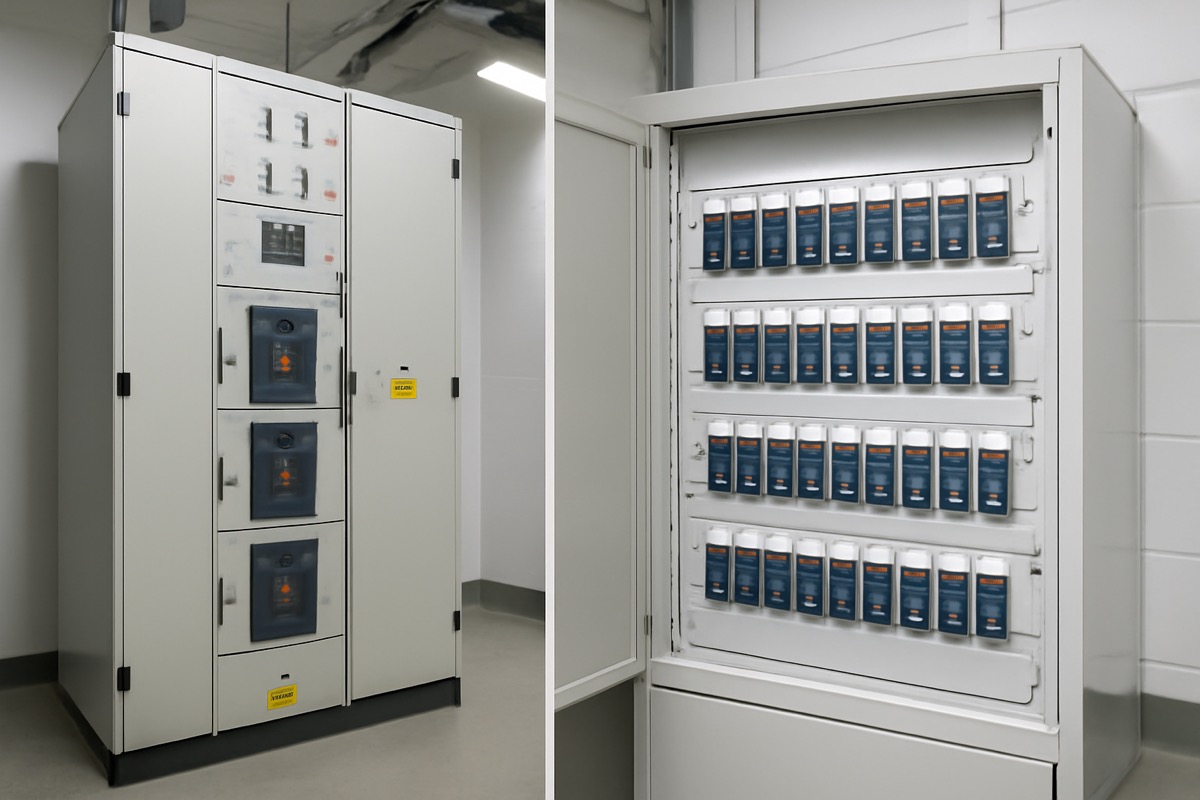
Quick Answer: Switchgear vs Switchboard
Switchgear operates at medium and high voltage (above 1 kV), contains circuit breakers that can interrupt massive fault currents, and is built with heavy-duty safety features. A switchboard operates at low voltage (below 1 kV) and distributes power to branch circuits within a building. They serve different roles in the power system hierarchy and are typically used together — switchgear upstream of the transformer, switchboard downstream.
What Is Switchgear?
Switchgear is a general term for electrical equipment used to control, protect, and isolate sections of a power system. In practice, the term most often refers to medium-voltage (MV) and high-voltage (HV) assemblies containing circuit breakers, disconnectors, current transformers, protection relays, and bus bars — all housed within robust metal enclosures. For a deep dive into how metal-clad and metal-enclosed construction differ, see our comparison.
Key characteristics of switchgear:
- Voltage range: 1 kV to 800+ kV (medium voltage: 1-52 kV; high voltage: above 52 kV)
- Circuit breakers: Vacuum or SF6 breakers rated for 20-50+ kA fault interruption
- Safety features: Compartmentalization, internal arc resistance, automatic shutters, interlocking
- Size: Large, floor-standing equipment requiring dedicated electrical rooms
- Standards: IEC 62271-200 (MV), IEC 62271-203 (GIS), GB 3906
- Function: Protects transformers, generators, feeders, and major distribution circuits
Switchgear is manufactured in several forms:
- Air-Insulated Switchgear (AIS): Uses air for insulation, larger but simpler
- Gas-Insulated Switchgear (GIS): Uses SF6 or nitrogen gas, extremely compact
- Metal-Enclosed Switchgear: Metal housing with various compartmentalization levels
What Is a Switchboard?
A switchboard is a low-voltage power distribution assembly that receives power from a transformer secondary (or utility low-voltage supply) and distributes it to multiple branch circuits through individual protective devices.
Key characteristics of switchboards:
- Voltage range: 230 V to 690 V AC (below 1 kV)
- Protective devices: Air circuit breakers (ACB), molded-case circuit breakers (MCCB), fuses
- Rated current: Typically 1000 A to 6300 A main bus
- Size: Floor-standing panels, typically 2-2.5 m height
- Standards: IEC 61439, GB 7251
- Function: Distributes power to motors, lighting panels, HVAC, and other loads
NAIJI Electric offers both GCS draw-out switchgear (up to 4000 A) and GGD fixed switchgear (up to 3150 A) for low-voltage distribution applications, along with the EZMX1 air circuit breaker (up to 6300 A) for main incoming protection.
Switchgear vs Switchboard: Side-by-Side Comparison
| Parameter | Switchgear (MV/HV) | Switchboard (LV) |
|---|---|---|
| Voltage | 1 kV - 800+ kV | 230 V - 690 V |
| Primary Function | Protect transformers, generators, feeders | Distribute power to branch circuits |
| Circuit Breaker Type | Vacuum or SF6 (high interrupting capacity) | ACB or MCCB |
| Fault Interrupting Capacity | 20 - 50+ kA | 10 - 100+ kA (ACB/MCCB rated) |
| Bus Rating | 630 A - 5000 A | 1000 A - 6300 A |
| Compartmentalization | Fully compartmentalized with barriers | Partially or not compartmentalized |
| Internal Arc Protection | IAC rated (50 kA/1s typical) | Usually not arc-rated |
| Insulation | Air, SF6, or vacuum | Air |
| Position in System | Upstream (utility side of transformer) | Downstream (load side of transformer) |
| Standards | IEC 62271-200, GB 3906 | IEC 61439, GB 7251 |
| Cost | Higher (specialized equipment) | Lower (commodity components) |
| Maintenance | Specialized technicians required | Standard electricians can service |
Where Each Fits in the Power System
A complete industrial or commercial power distribution system typically follows this hierarchy:
- Utility supply at high voltage (33 kV, 66 kV, or 110 kV)
- High-voltage switchgear at the point of supply (if applicable)
- Step-down transformer (HV to MV, e.g. 33 kV to 11 kV)
- Medium-voltage switchgear (11 kV or 12 kV) — distributes to multiple transformers
- Distribution transformer (MV to LV, e.g. 11 kV to 400 V)
- Low-voltage switchboard (400 V) — distributes to branch circuits
- Panelboards / distribution panels — final distribution to loads
In smaller facilities that receive power directly at low voltage from a utility transformer, steps 1-4 are handled by the utility and only the switchboard (step 6) and panelboards (step 7) are needed on the customer side.
When You Need Switchgear
- Your facility receives power at medium voltage (above 1 kV) from the utility
- You have on-site transformers that need upstream protection
- Your facility has large motors (above 300 kW) that run at medium voltage
- You need to distribute power to multiple buildings or zones at medium voltage
- The fault level at your point of supply exceeds what LV equipment can handle
- Code or utility requirements mandate medium-voltage metering and protection
Typical facilities: factories, power plants, mines, data centers (>5 MW), hospitals, large commercial complexes, substations, renewable energy plants.
When You Need a Switchboard
- Your facility receives power at low voltage (400/480/690 V) from a utility transformer
- You need to distribute power to many branch circuits (motors, lighting, HVAC)
- Total load current exceeds what a simple panelboard can handle (above 400 A)
- You need centralized metering and monitoring of multiple circuits
- Motor control centers (MCCs) are required for multiple motor starters
Typical facilities: office buildings, retail centers, small to medium factories, schools, residential complexes.
The Middle Ground: Low-Voltage Switchgear
There is an important category that bridges switchgear and switchboards: low-voltage switchgear. These are assemblies that operate below 1 kV but are built to switchgear-grade standards with compartmentalization, draw-out breakers, and high fault ratings (up to 100+ kA). They are used when the low-voltage system demands the safety and flexibility features of switchgear.
NAIJI Electric's GCS series is a draw-out type low-voltage switchgear rated at 4000 A / 50 kA, suitable for industrial power distribution and motor control centers. The GGD series offers a cost-effective fixed-type alternative at 3150 A / 30 kA for commercial and municipal applications.
NAIJI Electric: Complete MV and LV Solutions
NAIJI Electric provides a complete range covering both sides of the power system:
Medium-Voltage Switchgear
- ASN3-12 — 12 kV, up to 5000 A / 50 kA, internal arc 50 kA/1s
- ASN2-24 — 24 kV, up to 4000 A / 40 kA
- ASN1-40.5(G) — 40.5 kV, up to 3150 A / 40 kA
- GSN3-12 / GSN1-40.5L — Gas-insulated compact switchgear
Low-Voltage Switchgear & Switchboards
- GCS — Draw-out type, 4000 A main bus, for MCC and power distribution
- GGD — Fixed type, 3150 A, cost-effective distribution
- EZMX1 ACB — Up to 6300 A, one of the world's most compact ACBs
- EZM1 MCCB — 16-630 A, distribution and motor protection
Need help selecting the right combination of MV switchgear and LV switchboards for your power distribution project? Contact the NAIJI Electric engineering team for a system design consultation.