Quick Answer: Load Break Switch or Circuit Breaker?
If you need to interrupt fault currents (short circuits, overloads, ground faults), you need a circuit breaker. If you only need to switch normal load currents on and off — and fault protection is handled by an upstream breaker or fuse — a load break switch (LBS) does the job at 30-50% of the cost and in a smaller footprint.
This distinction sounds simple, but selecting the wrong device is one of the most expensive mistakes in medium-voltage distribution design. Installing circuit breakers at every switching point wastes budget. Installing load break switches where fault interruption is needed creates a protection gap that can destroy equipment or cause safety incidents. This guide provides the engineering basis for making the right choice at every point in your network.
For background on the medium-voltage switchgear landscape, see our complete MV guide.
What Is a Load Break Switch (LBS)?
A load break switch is a mechanical switching device that can make, carry, and break normal load currents and make and carry (but not break) short-circuit currents. It is designed to IEC 62271-103, which defines the switching duties and endurance requirements for switches rated above 1 kV.
The key operating principle: when the LBS contacts separate under load, a small arc forms. The arc-extinguishing medium — either SF6 gas or vacuum — quenches this arc within 20-50 milliseconds. But the arc energy the LBS can handle is limited to normal load currents (typically 400-630A). If a 20 kA fault current flows through the switch, the arc energy would far exceed the device's quenching capability, potentially destroying the contacts and causing an arc flash explosion.
Load break switches are engineered to withstand short-circuit currents without damage (rated short-time withstand current of 20-25 kA for 1 second), but they must remain closed during fault conditions — the upstream circuit breaker clears the fault.
Common LBS types in medium-voltage distribution:
- SF6 load break switch: Uses sealed SF6 gas chamber for arc quenching and insulation. Extremely compact. Most widely used type in ring main units (RMUs). Design life 30 years, 5,000 mechanical operations. See our detailed SF6 LBS guide.
- Vacuum load break switch: Uses vacuum interrupter for arc quenching. SF6-free, gaining market share due to environmental regulations. Higher mechanical life (up to 10,000 operations).
- Air-insulated load break switch: Uses air as the insulating medium with puffer or magnetic arc-blowing for arc quenching. Larger physical size but no gas handling required.
NAIJI Electric manufactures the FZW28-12 boundary load break switch and the FLW36-12 SF6 LBS for 12-36 kV distribution networks, both type-tested to IEC 62271-103.
What Is a Circuit Breaker?
A circuit breaker is a mechanical switching device that can make, carry, and break currents under normal conditions and also make, carry for a specified time, and break currents under specified abnormal conditions — including short-circuit faults. It is designed to IEC 62271-100, which defines the performance requirements for high-voltage circuit breakers.
The fundamental capability that separates a circuit breaker from a load break switch is fault current interruption. When a 20-50 kA short-circuit current flows through a circuit breaker, the arc-extinguishing technology (vacuum or SF6) quenches the arc at the first current zero crossing, typically within 40-60 milliseconds (3 cycles at 50 Hz). The circuit breaker contacts, arc chambers, and operating mechanisms are engineered to withstand the enormous electromagnetic and thermal forces generated during fault interruption.
At the 12-36 kV medium-voltage level, two circuit breaker technologies dominate:
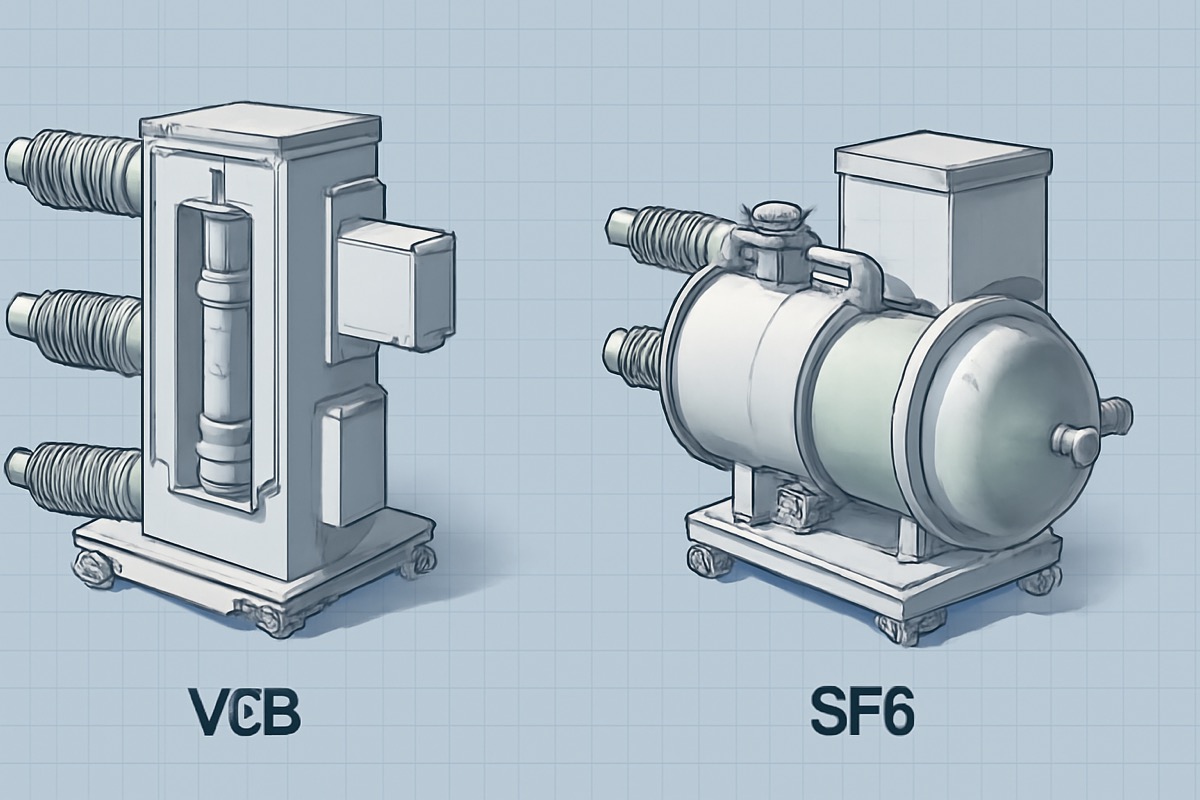
- Vacuum circuit breaker (VCB): Uses a sealed vacuum interrupter. Rated breaking capacity 16-50 kA. Mechanical life 10,000-30,000 operations. The dominant MV breaker technology worldwide. See our VCB vs SF6 comparison.
- SF6 circuit breaker: Uses SF6 gas for both insulation and arc quenching. Rated breaking capacity 16-50 kA. Mechanical life 3,000-10,000 operations. Preferred where compact gas-insulated construction is needed.
NAIJI Electric's VS1-12 indoor vacuum circuit breaker delivers up to 31.5 kA breaking capacity at 12 kV, while the ZW32-12 outdoor VCB serves pole-mounted applications with 20 kA breaking capacity.
LBS vs Circuit Breaker: Head-to-Head Comparison
The following table compares load break switches and circuit breakers across 12 critical parameters. Values are based on typical 12 kV class equipment — the most common voltage level in global distribution.
| Parameter | Load Break Switch (LBS) | Circuit Breaker (CB) |
|---|---|---|
| Design standard | IEC 62271-103 | IEC 62271-100 |
| Load current interruption | Yes — up to 630A | Yes — up to 4,000A |
| Fault current interruption | No | Yes — 16 to 50 kA |
| Short-time withstand (1s) | 20-25 kA (passes through) | 20-50 kA (interrupts) |
| Making capacity (peak) | 50 kA | 50-125 kA |
| Arc-extinguishing medium | SF6 gas or vacuum | Vacuum or SF6 gas |
| Mechanical life | 5,000-10,000 operations | 10,000-30,000 operations |
| Protection relay integration | Typically none (manual or motorized) | Yes — overcurrent, earth fault, differential |
| Trip coil / automatic tripping | Optional (motorized versions only) | Standard (shunt trip, undervoltage) |
| Physical size (12 kV, 630A) | Compact — ~300 × 400 × 600 mm | Larger — ~600 × 800 × 1200 mm (panel) |
| Relative cost | 1× (baseline) | 2-3× the LBS cost |
| Typical service life | 30 years | 25-30 years |
The critical row is fault current interruption. Everything else — cost, size, complexity — flows from whether the device needs this capability.
When to Use a Load Break Switch
A load break switch is the correct choice when all of the following conditions are met:
- Fault protection exists upstream. A circuit breaker or fuse at the substation or feeder head provides short-circuit and overcurrent protection for the downstream section.
- The switching point only needs load-current control. The device is used for routine switching operations — energizing/de-energizing cable sections, transferring load between sources, isolating equipment for maintenance.
- Load current does not exceed 630A. Most LBS units are rated 400A or 630A. Higher currents require circuit breakers.
- No protection relay coordination is needed at this point. The switching point does not need to discriminate between fault types or provide time-graded protection.
Typical applications where load break switches are the standard choice:
- Ring main unit (RMU) ring connections: The two cable-in/cable-out positions in an RMU use LBS units to connect the ring. The transformer feeder uses a circuit breaker or fuse-switch. This is the single largest application for load break switches worldwide.
- Cable sectionalizing points: Underground cable networks use LBS units at branching points to isolate sections for maintenance or fault location without de-energizing the entire ring.
- Compact substations: Packaged transformer substations in urban areas use LBS on the MV side to switch the transformer, with fuse protection for fault clearance.
- Boundary switches: Customer intake points where the utility needs to switch the customer's supply on/off. NAIJI's FZW28-12 is designed specifically for this application with integrated fault indication.
- Bus section switches: Industrial MV busbars use LBS to sectionalize the bus when fault protection is provided by the main incoming circuit breaker.
When to Use a Circuit Breaker
A circuit breaker is required when any of the following conditions apply:
- Fault current must be interrupted at this point. The device is the primary or backup protection element for the downstream equipment.
- Protection relays are needed. Overcurrent (50/51), earth fault (50N/51N), differential (87), or other protection functions require a circuit breaker to execute the trip command.
- Automatic reclosing is required. Distribution automation schemes (auto-recloser, FLISR) need circuit breakers that can open on fault, wait, and reclose automatically. See our recloser vs sectionalizer guide.
- Load current exceeds 630A. Generator feeders, transformer secondaries, and main bus connections often carry 1,000-4,000A — beyond LBS ratings.
- Selective coordination is needed. Time-graded or current-graded protection schemes require circuit breakers with adjustable relay settings to achieve selectivity between upstream and downstream devices.
Typical applications requiring circuit breakers:
- Substation incoming/outgoing feeders: Every substation breaker must interrupt fault currents to protect transformers, cables, and downstream equipment.
- Transformer protection: Both primary and secondary sides of power transformers need circuit breaker protection (overcurrent + differential).
- Generator connections: Generator circuit breakers must handle both fault current and generator contribution to faults on the network.
- Motor feeders: Large MV motors (>100 kW) require circuit breakers with motor protection relays (locked rotor, stall, thermal).
- Capacitor bank switching: Capacitor banks produce high inrush currents and require breakers designed for capacitive switching duties.
- Distribution automation: Smart grid schemes with fault location, isolation, and service restoration (FLISR) need breakers at key network points.
Real-World Example: Ring Main Unit Configuration
The most common real-world example of LBS and circuit breaker working together is the ring main unit (RMU). A standard RMU has three functional units:
| Position | Device | Function | Why This Device? |
|---|---|---|---|
| Cable In | Load Break Switch | Connects incoming ring cable | Only needs to switch load current. Fault on the ring is cleared by substation breaker. |
| Cable Out | Load Break Switch | Connects outgoing ring cable | Same as cable in — load switching only. |
| Transformer Feeder | Circuit Breaker or Fuse-Switch | Protects the distribution transformer | Must interrupt transformer faults (inrush, winding fault, secondary short circuit). |
This LBS + LBS + CB/fuse configuration is the global standard for underground distribution. Using a circuit breaker for the ring positions would increase the RMU cost by 40-60% with no improvement in network protection — because the ring cable faults are already cleared by the substation breakers at both ends of the ring.
NAIJI Electric's XGN15-12 ring main unit uses this proven architecture with SF6-insulated load break switches and a vacuum circuit breaker for the transformer feeder, providing a compact, maintenance-free solution for 12 kV urban distribution networks.
Cost Analysis: LBS vs Circuit Breaker
The cost difference between load break switches and circuit breakers is significant at scale. Here is a representative cost comparison for 12 kV, 630A equipment (FOB China, 2026 pricing):
| Cost Factor | SF6 Load Break Switch | Vacuum Circuit Breaker | Savings with LBS |
|---|---|---|---|
| Unit cost | $300-800 | $1,200-3,000 | 50-75% |
| Panel/enclosure cost | $500-1,000 (compact) | $1,500-3,000 (full switchgear) | 40-65% |
| Protection relay | Not required | $200-800 | 100% |
| CT/VT instrument transformers | Not required | $150-400 | 100% |
| Installation labor | Lower (lighter, fewer connections) | Higher (heavier, relay wiring) | 30-50% |
| Total installed cost | $1,000-2,000 | $3,000-7,000 | 55-70% |
| Annual maintenance | ~$50 (visual inspection) | ~$200 (relay testing, contact checks) | 75% |
For a distribution network with 50 switching points where 35 only need load-switching capability, using LBS instead of circuit breakers at those 35 points saves approximately $70,000-175,000 in equipment cost alone — before installation and lifetime maintenance savings.
Selection Decision Guide
Use this decision logic to determine whether each switching point in your network needs an LBS or circuit breaker:
Step 1: Does this point need to interrupt fault current?
- Yes → Circuit breaker required. Proceed to select VCB or SF6 type. See our VCB vs SF6 comparison.
- No → Continue to Step 2.
Step 2: Is there upstream fault protection (breaker or fuse)?
- Yes → Continue to Step 3.
- No → Circuit breaker required. Every fault path must have at least one fault-clearing device.
Step 3: Is the maximum load current ≤ 630A?
- Yes → Load break switch is appropriate. Select SF6 or vacuum type based on environmental requirements.
- No → Circuit breaker required. LBS ratings do not extend above 630A.
Step 4: Are protection relays needed at this point?
- Yes → Circuit breaker required. Protection relays need a breaker to execute trip commands.
- No → Load break switch confirmed.
Common Specification Mistakes
Based on our experience manufacturing and supplying switchgear to 30+ countries, these are the most frequent LBS vs circuit breaker specification errors we see:
Mistake 1: Over-specifying circuit breakers everywhere. Some engineers default to circuit breakers at every switching point "for safety." This wastes 40-60% of the switchgear budget. The ring cable positions in an RMU do not benefit from circuit breaker protection — the substation breakers already protect these cables. Proper protection coordination studies, not blanket circuit breaker installation, provide safety.
Mistake 2: Using LBS without verifying upstream protection. An LBS at a cable branch point only works safely if the upstream substation breaker can detect and clear faults on that branch within the LBS's short-time withstand capability (typically 20 kA / 1 second). If the upstream protection is too slow or the fault current exceeds the LBS withstand rating, the LBS can fail catastrophically. Always verify the short-circuit rating and upstream protection clearing time.
Mistake 3: Confusing "load break switch" with "disconnector." A disconnector (isolator) has no load-breaking capability — it can only be operated when the circuit is already de-energized. An LBS can switch load current. Operating a disconnector under load will cause an uncontrolled arc. These terms are not interchangeable despite being confused in some markets.
Mistake 4: Ignoring the making capacity. An LBS must be able to close onto a fault (making capacity, typically 50 kA peak) even though it cannot interrupt fault current. If the prospective fault current at the LBS location exceeds its making capacity, the LBS contacts may weld shut on the first fault, making it permanently inoperable. Check both the short-time withstand and making capacity against the system fault level.
Applicable Standards
The two devices are governed by different sections of the IEC 62271 series:
| Standard | Covers | Key Tests |
|---|---|---|
| IEC 62271-100 | High-voltage alternating-current circuit-breakers | Short-circuit making and breaking, TRV withstand, mechanical endurance (10,000 Class M2) |
| IEC 62271-103 | Switches for rated voltages above 1 kV up to 52 kV | Load-breaking, loop-switching, cable-charging, mechanical endurance (5,000 Class M2) |
| IEC 62271-200 | AC metal-enclosed switchgear and controlgear for rated voltages above 1 kV up to 52 kV | Internal arc withstand, dielectric tests, temperature rise — applies to both LBS and CB panels |
When sourcing switchgear, always request the type test reports for the applicable IEC standard. A load break switch must be type-tested to IEC 62271-103; a circuit breaker to IEC 62271-100. Reports from CNAS/ILAC-accredited labs (such as XIHARI in China) confirm that the device meets all performance requirements under the most severe rated conditions.
NAIJI Electric Load Break Switches and Circuit Breakers
NAIJI Electric manufactures both product categories, type-tested to IEC standards and deployed across 30+ countries:
Load Break Switches:
- FZW28-12 — 12 kV boundary load break switch with integrated fault indicator, motorized operation, GSM/GPRS remote control. Ideal for distribution automation and customer boundary points.
- FLW36-12 — 12 kV SF6 load break switch for RMU integration and standalone sectionalizing applications. 630A rated current, 20 kA / 1s short-time withstand.
Circuit Breakers:
- VS1-12 — 12 kV indoor vacuum circuit breaker. Up to 2,500A / 31.5 kA. Spring operating mechanism, 30,000 mechanical operations. For metal-clad and metal-enclosed switchgear.
- ZW32-12 — 12 kV outdoor pole-mounted VCB. 630A / 20 kA. Auto-recloser capable. For overhead distribution networks.
- ZW32-24 — 24 kV outdoor VCB for higher-voltage distribution.
- LW36-12 — 12 kV outdoor SF6 circuit breaker. 25 kA breaking capacity.
Need help determining whether your application requires a load break switch or circuit breaker? Our engineering team provides free application review and protection coordination consultation. Contact NAIJI Electric →
Related guides: SF6 Load Break Switch Guide | VCB vs SF6 Comparison | Ring Main Unit Guide | Short-Circuit Rating Guide